
Furniture Design Trends 2026: Materials, Colours and Shapes You’ll See Next Year…
The furniture landscape in 2026 isn’t defined by one overarching idea like “sustainability” or “minimalism.” Instead, we’re seeing a refinement of familiar styles — Scandi, Glam, Japandi, Organic Modern, Brutalist and Heritage — each quietly reinventing itself through material choices, proportion, and tactility. The changes are subtle but significant: edges are softening, surfaces are becoming more honest, and craft is being brought back into focus.
From Milan to Maison&Objet, designers and retailers are responding to a shift in how people want to live — seeking warmth, comfort, and depth without excess. These six trends represent where design is heading in 2026: more natural, more personal, and more human in both form and finish.
1 — Scandi 2.0

What changes (shape + silhouette)
Moves away from strictly minimalist, linear pieces toward rounded, plump silhouettes: lower, wider sofas with deeper seating and wraparound arm-returns; chairs with continuous curved backs that meet the seat (think single-volume forms).
Legs get shorter and stubbier — still intentionally visible to retain lightness, but thicker section profiles for a more grounded look.
Colour / CMF / finish details
Warmer neutrals replace cool greys: mocha, clay, warm taupe and “browned” beiges. Wood tones shift from pale bleached oak to honey and caramel oaks and lightly smoked ash.
Metals are muted (satin brass, aged nickel) rather than high-polish chrome.
Textures & fabrics
Bouclé, low-pile looped wools and heavy-weight linens for upholstery — tactile rather than perfectly smooth. Mixed upholstery panels (e.g., boucle seat + leather arm cap) to read as crafted.
Subtle fluting or ribbing as an accent on cabinet doors and upholstery piping — a nod to the tactile while retaining simplicity.
Construction & detailing
Exposed, refined joinery: visible dowel or pegged legs (modernised) rather than hidden fasteners.
Wall of modular pieces: more plug-and-play modular sofas in asymmetrical shapes that stack visually but feel handcrafted.
Why this shift?
Consumers want warmth and comfort after years of austere minimalism; Scandinavian design keeps its calm restraint but with more materially obvious, tactile quality. Salone/Milan coverage shows the move toward “comfortable, reassuring interiors” and chunky, voluminous forms.
2 — Quiet Glamour

What changes (shape + silhouette)
Glam tones down overt bling: silhouettes are still sculptural and statement-making but with softer curves and architectural restraint (e.g., a crescent sofa or low-arched headboard with hidden seams).
Furniture becomes more “collectible sculpture” — oversized mirrors, console tables with dramatic but refined supports.
Colour / CMF / finish details
Jewel tones survive (deep teal, aubergine, ink blue) but are sanded down with desaturated, smoky variants — think “muted jewel.”
Finishes move from mirror-polished brass to satin/brushed brass, bronze with soft patina and walnut burl with matte protective lacquers.
Marble and stone surfaces trend toward fluted or honed finishes rather than high-gloss; veins are emphasized but surfaces are soft to the touch.
Textures & fabrics
Plush velvets (short, dense), dense boucle and heavyweight silk mixes. Layering of textures is key: velvet cushions + nubby throws + leather piping.
Hardware is minimal but sculptural — integrated pulls, elongated recessed handles in metal with satin finishes.
Construction & detailing
Edge details: radiused edges on stone tops and furniture corners (softer, tactile luxury).
Inset contra-detailing: e.g., a brass inlay around a drawer face rather than entire brass cladding.
Why this shift?
High-end retail and Milan shows are presenting glamour as statement comfort and collectible industrial-sculpture pieces, not showroom bling — a more considered, tactile glamour that reads expensive without shouting.
3 — Japandi Warm Restraint
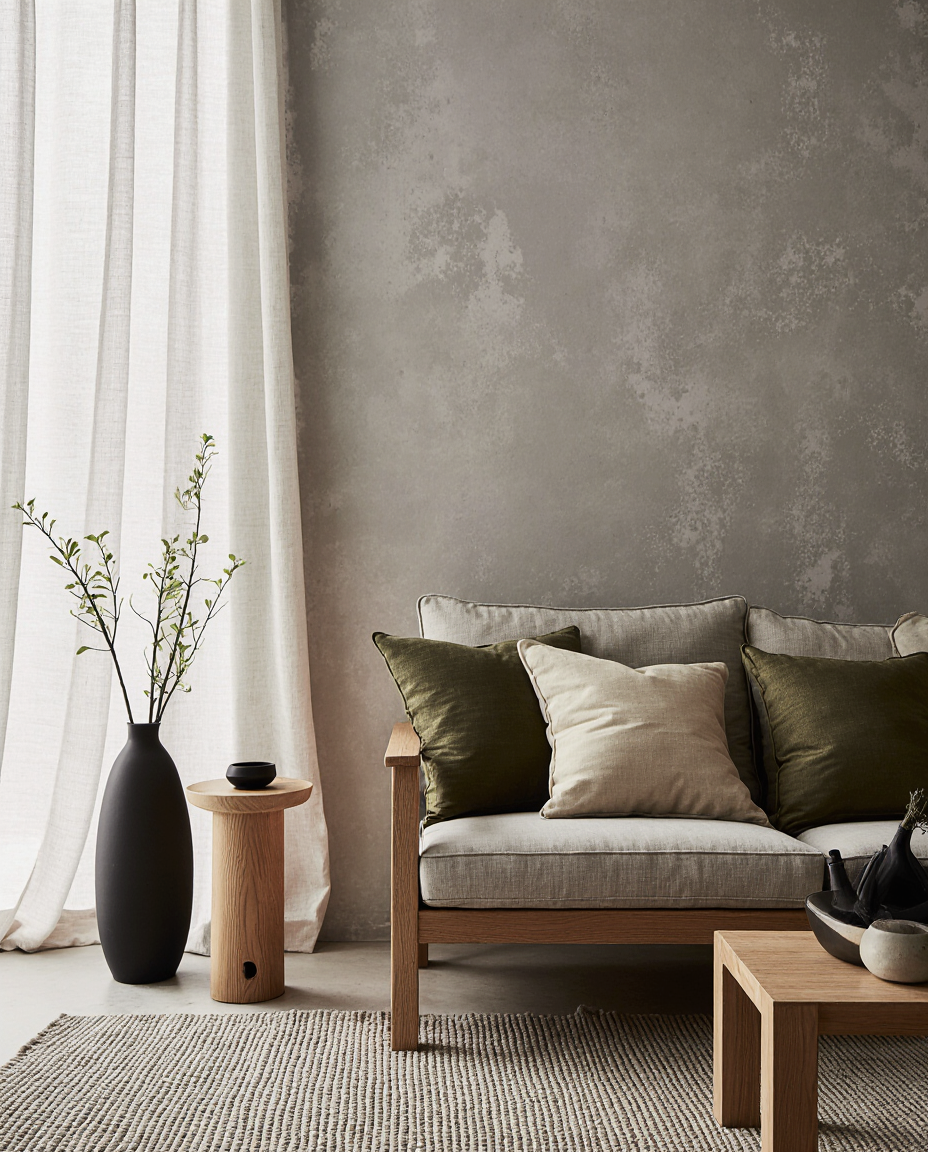
What changes (shape + silhouette)
Low, horizontal profiles remain, but curves are smoother and joinery is more visible and celebrated (bridging Japanese precision with Scandinavian warmth).
Slightly more presence: furniture is slightly larger in proportion (wider benches, longer low tables) to read as “anchoring” rather than minimal décor.
Colour / CMF / finish details
Palette: paper-washed neutrals, sumi blacks and a new focus on warm grey-olive and mushroom tones. Wood finishes lean to hand-rubbed oaks and walnut with matte oils (no high-gloss lacquer).
Ceramic and hand-glazed stoneware for tops and accents (subtle glaze cracking accepted as a feature).
Textures & fabrics
Natural woven textile panels, hand-stitched upholstery details, and steamed-wood bending visible in chair arms. Linen blends with heavier weaves are used for durability but appear soft.
Construction & detailing
Emphasis on small, elegant joinery details — tenons, dovetails, and exposed pegging used as aesthetic devices.
Slim, integral handles (cut-outs or recessed wooden pulls) instead of metal hardware.
Why this shift?
Japandi’s quiet aesthetic continues but matures: consumers want studio-like restraint that still feels warm and artisanal. Ideal Home and trade coverage flag Japandi still being relevant into 2026 but evolving toward warmer, more textural expressions.
4 — Biomorphic Luxury

What changes (shape + silhouette)
Strong move to biomorphic, freeform shapes — sofas that look hand-sculpted, coffee tables with irregular stone or resin tops, and seamless transitions between back and arm.
Curves become compound (multi-radius) rather than simple arcs — gives pieces a more natural, “grown not built” appearance.
Colour / CMF / finish details
Earth-forward palette: terracotta, warm greens (sage to olive), ochres, and deep root browns.
Materials: timber (burnt/charred finishes), mineral terrazzo with recycled aggregates, and algae-based or bio-resin surfaces.
Textures & fabrics
Recycled boucle, felted wools, and upholstery with visible tufting or hand-finished seams. Surfaces are intentionally imperfect — tool marks, visible joins and hand-finishing are selling points.
Construction & detailing
Integrated planters, living edges on wood tables, and modular units that allow the addition of greenery.
Hidden hardware designed to facilitate repairability — visible bolts that are easy to service.
Why this shift?
Design shows highlight tactile, reassuring pieces and consumer desire for wellness-led interiors; biophilic forms satisfy both emotional and ecological purchase drivers. Salone and Maison&Objet trend messaging called out comforting, totemic sculptural pieces and “Metamorphosis / Revisited” themes.
5 — Refined Mass

What changes (shape + silhouette)
Heavy, sculptural silhouettes persist but with refinement: fluted massing, stepped profiles and layered planes that read as architectural furniture rather than raw blocks.
Pieces feel monolithic but have refined detailing at joins and edges.
Colour / CMF / finish details
Concrete and cast stone are paired with warm woods or leather to soften the read. Concrete is blended and precision-finished (honed, micro-fluted) rather than raw poured concrete.
Dark, inky colours (charcoal, deep sepia) as background with contrasting warm metal accents.
Textures & fabrics
Dense, heavyweight leathers, coarse boucle and tightly woven technical fabrics for abrasion resistance. Fluted concrete or ribbed surfaces are used as a repeating motif — on table bases, chair backs and cabinet facades.
Construction & detailing
Prefabricated, modular panels that interlock — intentionally visible plate-work and bracketry as an aesthetic.
Fluting and ribbing are manufactured with precision tooling — think CNC-milled stone and metal.
Why this shift?
Collectors and trade buyers want pieces that read like architecture/collectible objects. Shows in Milan indicate industrial-design-as-collectible and totemic sculptures — now with more finish-level sophistication.
6 — Revisited Ornament

What changes (shape + silhouette)
Reinterpretations of classical profiles (scalloped backs, restrained cabriole hints) but simplified and scaled for modern rooms. Proportions are cleaner — ornament is selective (a carved drawer face rather than a carved entire leg).
Colour / CMF / finish details
Rich woods (walnut, dark-stained oak) combined with inlaid marquetry or micro-marquetry panels in muted palettes. Lacquers are satin or brushed, not high-gloss.
Metal inlays (thin brass or bronze lines) used like graphic accents rather than full cladding.
Textures & fabrics
Hand-stitched leather, mohair blends and jacquards with subtle patterning. Embroidery or small hand-stitched motifs (e.g., channel stitching in unexpected places) appear as provenance markers.
Construction & detailing
Finishes that celebrate craft: blind mitres, hand-sanded transitions, and marquetry panels with subtle pattern repeats. Repairability and replaceability (e.g., replaceable upholstered panels) are specified at the design stage.
Why this shift?
There’s a return to tangible story and heritage but framed for modern buyers — the trend coverage at Maison&Objet explicitly called out “Revisited Baroque” and heritage themes rendered through contemporary craft. This is luxury that signals provenance without theatricality.
Key Summary for Furniture Designers & Retailers
CMF palettes: warm neutrals (mocha, clay, warm taupe) + smoked woods + muted jewel accents. (Use these consistently across ranges.) The Sun
Finish language: move from high-polish to satin / honed / brushed / oiled finishes. Reserve high gloss for small accent elements. salonemilano.it
Textures: incorporate bouclé, dense velvet, hand-woven textiles and recycled-content terrazzo; make tactile imperfection a selling point. thecontractchair.co.uk
Detailing that sells: visible refined joinery, subtle fluting, inset metal lines, radiused stone edges, replaceable upholstery panels. These are the micro-differences buyers will notice. maison-objet.com
Sourcing & marketing: call out repairability, local craftsmanship, recycled-content numbers and a short provenance story — trade shows show buyers preferring “collectible” narratives. salonemilano.it+1